


Are metals eternal?

Metals have been there since the development of ancient tools. But can we say that they last forever? Some metals such as steel may appear indestructible, however, they are constantly degrading by interacting with the environment.

Metals
Located on the left side and middle of the periodic table:
Alkali metals (Group 1, except for hydrogen): Li, Na, K, Rb, Cs, Fr.
Alkaline earth metals (Group 2): Be, Mg, Ca, Sr, Ba, Ra.
Transition metals (Groups 3-12): Sc, Ti, V, Cr, Mn, Fe, Co, Ni, Cu, Zn, etc.
Lanthanides and Actinides: La to Lu and Ac to Lr
Non-metals
Found on the right side of the periodic table:
Hydrogen (H)
Carbon (C)
Nitrogen (N)
Oxygen (O)
Phosphorus (P)
Sulfur (S)
Selenium (Se)
Halogens (Group 17): F, Cl, Br, I, At.
Noble gases (Group 18): He, Ne, Ar, Kr, Xe, Rn
In nature, metal elements are found combined with non-metal elements to neutralise their charges. For example, aluminium easily combines with oxygen and it is frequently found as aluminium oxide in bauxite. Extracting metals from their stable state requires complex and costly processes and, once isolated, they tend to return to their more stable combined state through corrosion, which causes the degradation of the metallic components.
Predicting Metal Corrosion and Degradation
There is a significant difficulty in accurately predicting the behaviour of a given metallic material in a specific real-world scenario. Although many of the processes behind the metal degradation that can occur under the most typical conditions are well understood, there remains a challenge in anticipating the changes that occur in corrosion processes and their rates, especially in the long term.
Understanding when and how a metal will fail is essential to prevent unexpected breaks or deterioration. One method would be to develop tools that allow us to explore this research path with more precise measurements and better data collection. This would enable more accurate anticipation of when and how the metallic material would begin to degrade or break.
Have you ever noticed the corrosion of metallic parts near the shore?


Places where special care is a must
Therefore, metals are not "eternal" as they are subject to changes and deterioration over time. However, some metals are more resistant than others in specific scenarios. This is where the science of metallurgy plays a crucial role. By studying the degradation of metals, metallurgists can identify the most suitable manufacturing conditions, compositions, and scenarios for metallic alloys to enhance their resistance to degradation, which leads to a longer and more controlled life of the metallic products.
There are some scenarios easier to resist than others. Some factors that accelerate the corrosion process are the humidity, temperature and especially the presence of salt which makes the humidity to be more conducive. Can you think of a very commonplace in nature where there are high concentrations of salt combined with humidity? Effectively, the sea! Special care is required if the metallic materials will be used in the sea:


The pipes also need special care, as the fluids inside them can contain corrosive compositions, or can be hot. The humidity produced by the liquids inside and condensation outside them, combined with any corrosive compositions, high temperatures or both, can be catastrophic if anti-corrosion measurements are not taken.

How can we prevent corrosion?
It is impossible to eliminate corrosion as it is a natural phenomenon that occurs in metallic materials, but measurements can be taken to reduce the metallic corrosion to an extreme where it is almost stopped. The easiest way to protect the metallic parts is with paint.

There are other more complex forms of protection against corrosion, like anodic protection, where another metallic component is connected to the part that needs to be protected. This component corrodes more easily and is sacrificed, as the corrosion consequences are focused on this protective material, the sacrificial anode. This is commonly used in the hulls of ships. Can you find them in the picture?

Hint
Let's look at this hull closely. Do you see the white rectangles?

These techniques prevent early corrosion. However, they are no permanent solutions and corrosion will emerge sooner or later. One strategy to delay corrosion is to apply many strategies to increase the protection as much as possible and as long as possible. For example, the ship in the pictures not only counted on the sacrificial anode but also on paint to have that double protection that is more effective together than both of them separately.

Pieces damaged by corrosion. Now what?
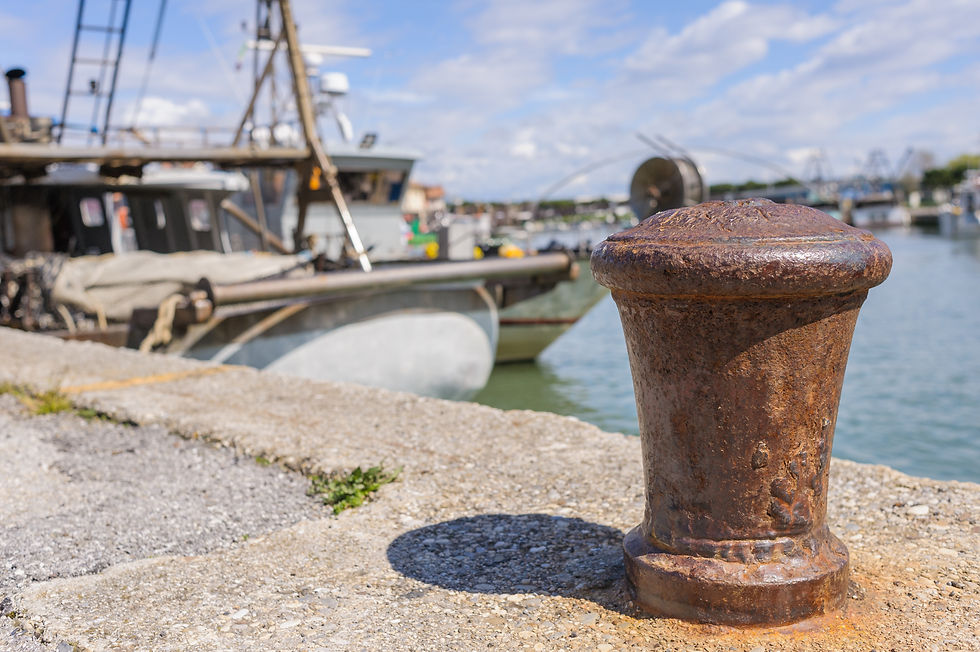
The big problem of corrosion is that once it damages the metallic part, the damage is irreversible. We can cut damaged sections and substitute them, or grind the surfaces to renovate their good aspect, but the damaged areas cannot be de-corroded. The corrosion entails the loss of material, as can be seen at the base of this bollard:

Prevention is fundamental and where all the work should be focused, rather than fixing the corroded component. The control and prevention of corrosion are fundamental to extend the lifetime of the metallic products in difficult scenarios like offshore and onshore, industries that use corrosive or hot fluids transportation, etc.
It is necessary to constantly develop and design new methods for protecting metals against corrosion so they can be used safely. Some applications entail risk if the metallic parts corrode and lose their mechanical properties. There are safety procedures specifying when the metallic pieces stop being safe to use and need to be replaced.


Comments